
Skip to content
Email Deliverability and Automation Expert Email Deliverability and Automation Expert
  • Home
  • ReengagePro
  • Email Deliverability
  • Blog
  • Clients
  • About
  • Contact Us
Email Deliverability and Automation Expert

How does Google Postmaster Tools calculate the spam rate?

Fabrício Yutaka Fujikawa, October 18, 2024October 18, 2024

I recently received an interesting question from a client about how Google Postmaster Tools calculates the spam rate. This is a crucial issue for those working in email marketing, so I thought it would be useful to share the answer with all of you.

The client’s full question was: “How is the spam rate calculated in Google Postmaster Tools?“

This is a common question, and the answer involves some important details that can significantly impact your deliverability metrics. Let’s take a closer look at this.

Spam rate calculation formula

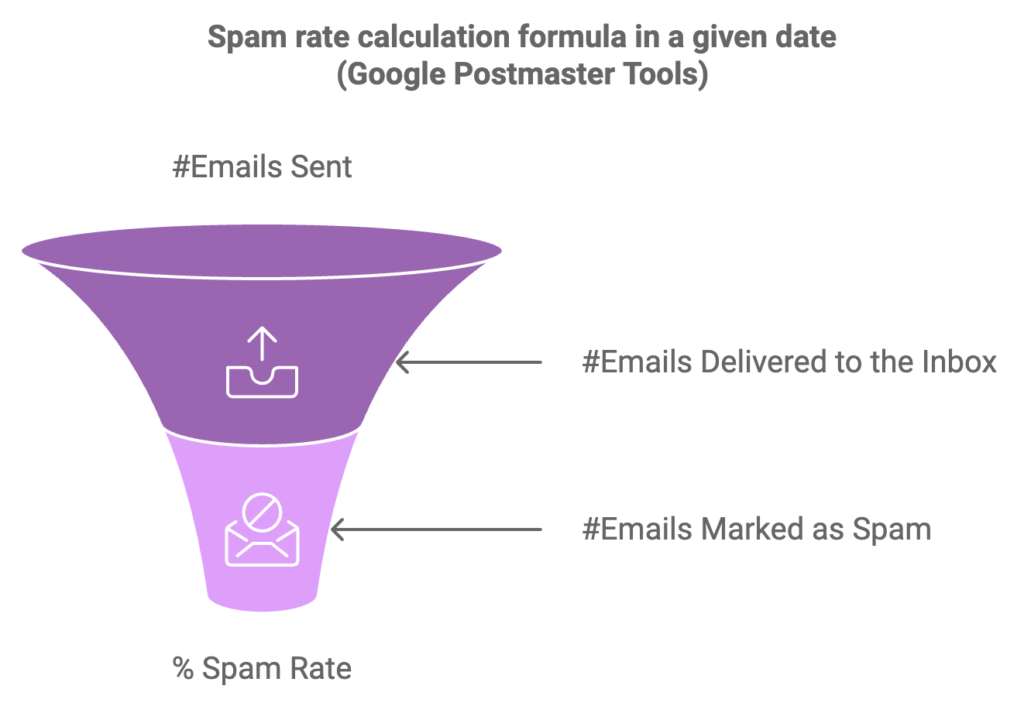
The spam rate calculation formula is relatively simple:

Spam Rate (%) = Number of Messages Marked as SPAM / Number of Messages Delivered to Inbox
Source: Google Postmaster Tools
However, there are some important nuances to consider:

The calculation is done for a given day, regardless of when the message was sent. For example, a message sent yesterday and marked as spam today will affect today’s spam rate.

Spam rate peaks can occur on unexpected days. For instance, in a case I analyzed, I noticed that over a 30-day period, the three peaks in the spam rate happened on Saturdays. This can be explained by:

  • “Delayed” spam markings for messages delivered on Friday.
  • If you send messages on Saturdays, people may be more likely to mark messages received on the weekend as spam.

It’s important to remember that Google Postmaster Tools metrics only refer to recipients @gmail.com or @googlemail.com.

Caveat: The accuracy of the spam rate is a recurring topic in email deliverability discussion groups. Fluctuations may not always reflect real changes in recipient behavior.

What does this mean for you?

  1. Monitor your metrics regularly, but don’t panic about short-term fluctuations.
  2. Pay special attention to long-term patterns and weekly trends.
  3. Consider adjusting your sending strategy if you consistently notice higher spam rates on certain days of the week.
  4. Keep a close eye on the compliance dashboard of Google Postmaster Tools metrics. This panel provides a quick overview of your sending reputation health and can alert you to potential problems before they become critical.

Remember, the most important thing is to comply with all of Google’s deliverability requirements. If you’re doing that, you can be at ease, but it’s always good to stay alert.

Do you have any questions about Google Postmaster Tools metrics or want to share your experience? Leave a comment below!

Until next time,
Fabrício.

Email Deliverability

Post navigation

Previous post
Next post

Related Posts

Deliverability Journal – Apr 11th, 2023

April 11, 2023June 17, 2023

This case is from a campaign where we’re defining the text of the seventh message of a sequence. I’m sharing a screenshot of the Google Doc we’re working on. The highlight is that the a/b test element will be an image (one variation with the image and the other without.)…

Read More
Email Deliverability

Why are your subscribers marking your emails as spam?

October 4, 2024October 7, 2024

Hi, I received an interesting question and thought it’d be helpful to share the answer with all of you. The issue was about a common problem in email marketing: “Why are my emails being marked as SPAM by subscribers who opted in to receive my newsletter?” This is a concern…

Read More

How to Warm Up a New Sender Domain

May 1, 2025April 30, 2025

Resend’s article, “How to Warm Up a New Domain,” offers a practical guide for establishing a solid reputation when you start sending emails from a new domain. Even with opt-in lists, or even double opt-in lists, it’s essential to follow a warming process to ensure high deliverability. Key Highlights Separation…

Read More

Leave a Reply Cancel reply

Your email address will not be published. Required fields are marked *


  • Case Studies
  • Email Deliverability
  • Email Deliverability Case Studies
  • Google Workspace
  • Others
  • Outbound Email Authentication: Security & Deliverability
  • Referral Marketing

  • Contact Us
  • Terms of Use
  • Privacy Policy
  • Cookie policy
©2026 Email Deliverability and Automation Expert | WordPress Theme by SuperbThemes
We use cookies on our website to give you the most relevant experience by remembering your preferences and repeat visits. By clicking “Accept”, you consent to the use of ALL the cookies.
Do not sell my personal information.
Cookie SettingsAccept
Manage consent

Privacy Overview

This website uses cookies to improve your experience while you navigate through the website. Out of these, the cookies that are categorized as necessary are stored on your browser as they are essential for the working of basic functionalities of the website. We also use third-party cookies that help us analyze and understand how you use this website. These cookies will be stored in your browser only with your consent. You also have the option to opt-out of these cookies. But opting out of some of these cookies may affect your browsing experience.
Necessary
Always Enabled
Necessary cookies are absolutely essential for the website to function properly. These cookies ensure basic functionalities and security features of the website, anonymously.
CookieDurationDescription
cookielawinfo-checkbox-analytics11 monthsThis cookie is set by GDPR Cookie Consent plugin. The cookie is used to store the user consent for the cookies in the category "Analytics".
cookielawinfo-checkbox-functional11 monthsThe cookie is set by GDPR cookie consent to record the user consent for the cookies in the category "Functional".
cookielawinfo-checkbox-necessary11 monthsThis cookie is set by GDPR Cookie Consent plugin. The cookies is used to store the user consent for the cookies in the category "Necessary".
cookielawinfo-checkbox-others11 monthsThis cookie is set by GDPR Cookie Consent plugin. The cookie is used to store the user consent for the cookies in the category "Other.
cookielawinfo-checkbox-performance11 monthsThis cookie is set by GDPR Cookie Consent plugin. The cookie is used to store the user consent for the cookies in the category "Performance".
viewed_cookie_policy11 monthsThe cookie is set by the GDPR Cookie Consent plugin and is used to store whether or not user has consented to the use of cookies. It does not store any personal data.
Functional
Functional cookies help to perform certain functionalities like sharing the content of the website on social media platforms, collect feedbacks, and other third-party features.
Performance
Performance cookies are used to understand and analyze the key performance indexes of the website which helps in delivering a better user experience for the visitors.
Analytics
Analytical cookies are used to understand how visitors interact with the website. These cookies help provide information on metrics the number of visitors, bounce rate, traffic source, etc.
Advertisement
Advertisement cookies are used to provide visitors with relevant ads and marketing campaigns. These cookies track visitors across websites and collect information to provide customized ads.
Others
Other uncategorized cookies are those that are being analyzed and have not been classified into a category as yet.
SAVE & ACCEPT